If you are Applying for more than one Type of Job, Have More than one CV.

Looking for a employment is a sales job.  It’s all about marketing your CV to potential employers, looking for opportunities, building your brand.  Whether you fancy yourself as a sales rep or not- tough- now is the time to learn how to sell.


And the first thing that you have to do, is get your brochure (CV) professionally and appropriately drawn up!


If you decide that you are a secretary and would happily be a secretary, but would equally like the idea of getting into Events/ PRO or Sales Coordination position, because you have already done a bit of this, then you need to have a cv that sells you for each line of work.   Similarly, you may be a draughtsman who is keen to also try mechanical engineering or technical sales.


The first page of your CV will remain the same for all the jobs you apply for.  This will contain your personal information, contact details and ideally a professional photograph of you.


The second page will contain your computer skills and education.  Here you will list the skills most relevant to the job you are apply for first, and in more detail than the less relevant qualifications.  It’s often a matter of just switching the order around.  But the person reading your CV will assign the most importance to the skills they read first and that dominates the page.  For example- you are a draughtsman applying for a technical sales position as well.  When you apply for the draughtsman jobs, the Dale Carnegie course is not really that relevant and would be at the bottom of the skills section, if there at all.  But if you are applying for a technical sales job, putting this first, immediately gives the impression you have people skills.


The next section is the career history.  Always start with the most recent job first, and put dates and duties.  But the duties that are relevant to the position you are applying for, should appear first, and in more detail.  A good example is that you are an Office Administrator/ General Accounts Clerk.  You want to apply for a debtor’s position.  You need to take your debtors duties and put them as the first duties under that place of employment.  You may have just written “Debtors” as one of many points.  Now you need to elaborate.  What is the size of your debtor’s book and how many accounts do you handle?  Do you do invoicing and statements? Do you phone for money? Do you allocate payments off the bank statement? Do you deal with debtors queries?  If the first 5 points listed under duties are debtors, even though after that are a bunch of other unrelated duties, you have still made the impression that you are a debtor’s clerk!


Finally, if you don’t have a lot of skills and experience in the area that you are applying, but it is your passion and you know a lot about it through your hobbies and research, then add this in.  If at all possible, include it under the career section and give examples of your work.  Maybe you designed a website in your own time to market your wife’s business?  Or you do your husbands bookkeeping in the evenings?  Or you won a quilting competition and you want to get into the textile industry.


When I look at your CV, and you are applying for a particular position, your CV needs to give the overall impression that you are suitable for that position.


But… never lie and misrepresent yourself.  You can promote and emphasise why you are suitable, but don’t ever lie.  One lie will discredit your whole CV.


Finally, The Golden Rule:- “If it’s not on your CV, you never did it.”

Getting Feedback on your Applications

GETTING FEEDBACK ON YOUR APPLICATIONS


Not getting feedback when you apply for jobs can be so frustrating and demotivating!  But, instead of being powerless in the job seeking process, why not  be more proactive with your communication and take control of the feedback process as much as you can?  Here are a few tips that may help you take control of the situation:-


The ability to communicate effectively and professionally at all levels, is a skills that all businesses seek.  It’s one of the first things that is assessed in interviews. You can be a genius, but if you can’t communicate, no one will ever know!  How you communicate before you even get the interview, and during the interview and shortlisting process, can make all the difference at the end of the day!

Listening & Interpreting Information
Being a good listener is one of the best ways to be a good communicator. No one likes communicating with someone who only cares about putting in her two cents, and does not take the time to listen to the other person.

Sometimes, recruiters put specific requirements on how to apply for a vacancy.  There are many reasons why they will do this, but failure to follow the instructions, will ensure that you start the process on a negative note.  If the application asks for CV’s to be emailed, faxed or posted- use this means to deliver your application.  And if they ask for a covering letter or supporting documentation (or none at all) – listen to the instructions.  If you are not communicating in the way they want, they may reject your application, without you even knowing, and this is the reason you are not being contacted for interviews.

Keep it short and to the point!
Good communication means saying just enough – don’t say too little or talk too much. Try to convey your message in as few words as possible. Say what you want clearly and directly, whether you’re speaking to someone in person, on the phone, or via email. If you ramble on, your listener will either tune you out or will be unsure of exactly what you want. Think about what you want to say before you say it; this will help you to avoid talking excessively and/or confusing your audience. Often people talk themselves out of a job. Nerves kick in and they start talking and just can’t stop and end up telling way more than they should.  Keep it short and sweet, and remember this is a professional exchange, not a friendly chat!

Friendliness
People like happy, friendly people. The effort it takes to smile, be friendly and patient; will be the best investment you can make when looking for a job. I know that you will get frustrated and irritated with the process, everyone does, but avoid making a phone call when you are in a negative mood, and check the tone of your email.

Be aware that when you get negative, stand your ground and confront a potential employer or recruiter, you may make your point, but chances are you will not get the job.  Always be assertive in a constructive, positive manner!


Picking the Right Medium
An important communication skill is to simply know what form of communication to use.

Initially, always follow the medium that the advert asks for the application.  This shows that you respect their process and can follow instruction.  If it is not stated, always apply in writing, via email.  Attached your CV and anything that is requested, but at the initial stage, avoid attaching lots of supporting documents.  Try and make the recruiter’s job as simple as possible.

From this point, you need to get the balance right- when it is appropriate to continue on email, phone or maybe even pop in to see the recruiter.  Too many phone calls or an unsolicited visit, may be inappropriate, but there is a lot to be said for picking up the phone.  (But never let anyone else phone on your behalf!!)

Feedback
And the most important bit of advice from this newsletter- ASK FOR FEEDBACK! As demotivating as it may be, it is a reality that you are one of hundreds of people applying for a position, and there is often just one person going through the CV’s and the process. If you want feedback you need to pick up the phone or send an email.  Not only will this give you constructive feedback on where your CV or skills may be lacking, but it is an opportunity to build relationships with the recruiter.  Knowledge is power, and knowing why you have not been short listed, can be extremely motivating (as strange as that may seem!).  If you have not passed the email stage of applying, then forward your original application, and ask for feedback (don’t make the recruiter go looking for your application).  If you have been in for a personal interview, then pick up the phone and start building relationships.

Relationships are a two way street, so don’t apply for a job and then wait to get a phone call.  Be proactive, and drive the process!  Start interacting with your recruiter, and I promise, you will be at the top of their minds next time a job comes in, and they will start communicating back!


How to look and feel POWERFUL in your next interview… even if you are not on the inside.

We all know the importance of making a good first impression, and the importance of body language in doing this.  It’s probably the single biggest weakness we see in job seekers attending interviews- they often let nerves get the better of them, which translates through poor body language as a negative attitude or presence.

Here are a few common mistakes we see with body language:-

  • Poor posture- slouching (lazy), leaning forward (like you going to make a run for it) and leaning back (too casual), can all send the wrong message. Sit up straight, without being rigid and look alert and engaged.
  • Eye Contact- make eye contact, especially when shaking hands, but be careful to not stare too long or have fidgety eyes- constantly looking around- like your attention is elsewhere.
  • Keep your arms neutral- don’t cross them, hold them behind your back or put them in your pockets.
  • Don’t fidget and bounce. This is the most common.  Interview nerves bring out the bouncy leg, the itches and hair that constantly needs adjusting.  And this nervous energy is distracting the interviewer from what you are actually saying.

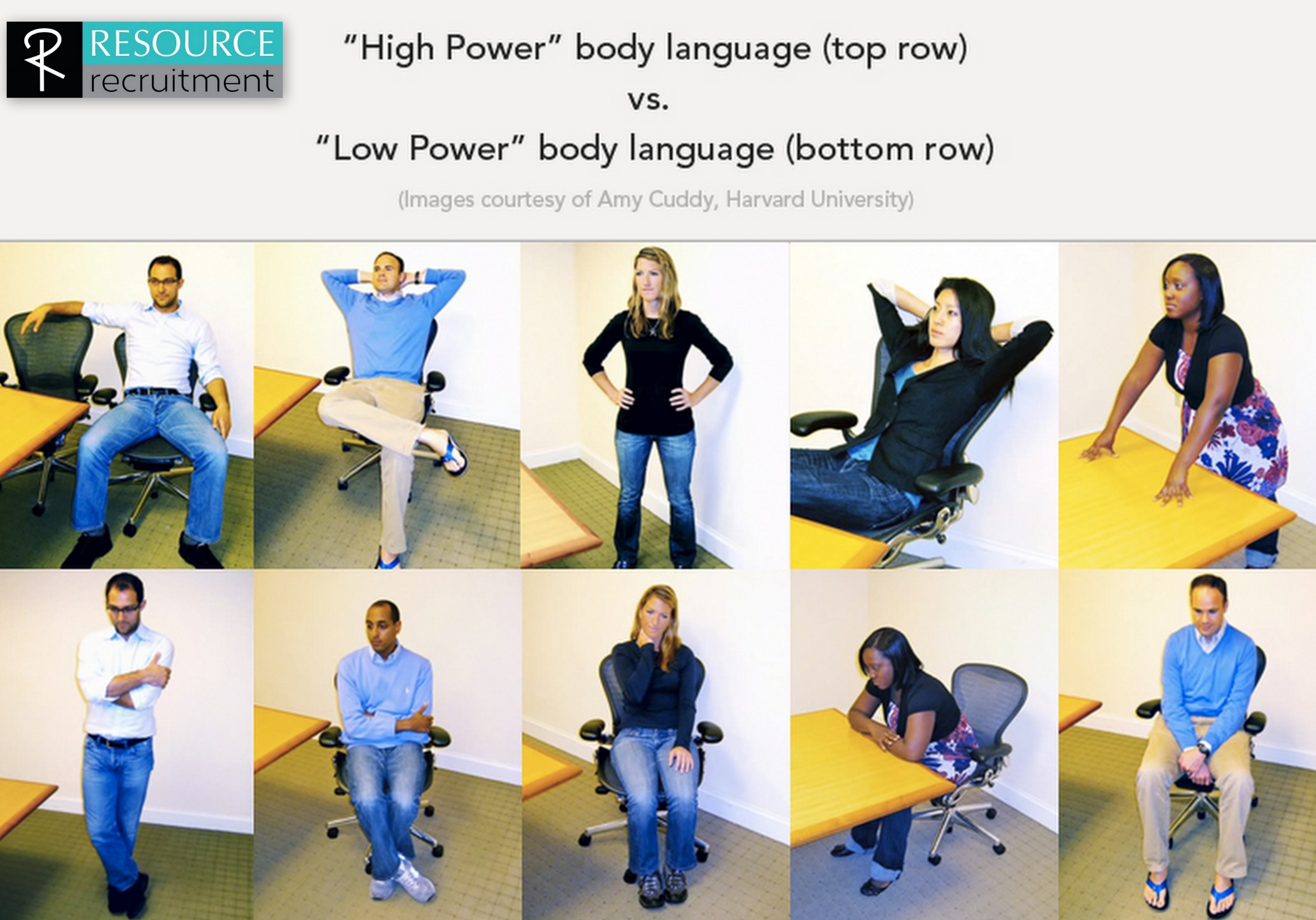
If poor body language can make us appear nervous, incapable, submissive, unconfident and negative, then what if the opposite was true?  What is we posed with the correct, empowering body language- would this make us feel and appear confident, positive, assertive and optimistic?  This is exactly what Amy Cuddy discovered in her research:-

Our minds may change our body (language),

but our body (language) can also change our minds!

Amy Cuddy researched one of life’s most simple tricks- Power Posing.  Power Posing is the act of taking a posture of confidence, even when you don’t feel confident, to make yourself more dominant.  (Its seen in nature with an ape banging his chest, a snake rises to attack and birds extend their wings and tail feathers to assert themselves.)  Her research showed that sitting or standing in a certain way, for as little as two minutes, raises testosterone levels and lowers stress hormones, and ultimately effects the way you interact with people.  Power Posing is especially beneficial when facing a “social threat” where you are being evaluated, such as negotiating deals, pitching ideas and job interviews.

Examples of High and Low Power Poses

Power Poses involve stretching the body to take up more space and appear more powerful.  Take a minute to stand up, feet slightly apart, hands on hips, shoulders back and chin slightly raised.  Or lean forward and put your hands on the desk, placed wider than your shoulders.  I am sure that you immediately feel the power shift if you have been sitting hunched over your computer or desk.


If you have 15 minutes to spare, and want to find out more, I would strongly recommend that you follow the link and watch Amy Cuddy explain power poses, give examples of various poses and show you how you can “Fake it until you Become it” (https://www.ted.com/talks/amy_cuddy_your_body_language_shapes_who_you_are) !  This article also elaborates more on 8 power poses for work, has some great pictures to illustrate the point. (http://www.businessinsider.com/power-poses-interview-body-language-2014-3 )


It’s the little changes that we make in life, that often have the biggest impact.  So, before your next interview, don’t sit in reception making yourself as small as possible.  Sit up straight, shoulders back, chin up and arms open; or take two minutes in the bathroom or parking lot before the interview, in a power pose.


Empower yourself so that when you leave the next interview, you know that you have showed the best there is of you, and made the best possible first impression!

peanut


15 Points to Consider when Compiling your CV.

  1. What will your CV look like when printed in black and white? Will it still be eye catching and easy to read?  Few companies will go to the cost of printing it in colour when reviewing it.
  2. If you are applying for jobs on line or via email- is your email address on your CV? If you are applying from Gumtree, Indeed and various other platforms, your application will not come from your personal email address, but from the portal address, so how will they be able to reply?
  3. If the best you can do is send an outdated, scribbled on, scanned CV, then you need to ask yourself: ”Am I serious about looking for a job?” Your CV is your first impression, and an indication of the best work you can produce, and the pride you take in your work.
  4. Don’t put generic comments in your covering email, such as “Application for before mentioned position” and then don’t mention what position it is. Or say “I have always wanted to work for your company” and send it to an employment agency, for a job with their clients.  It makes you application insincere from the outset.
  5. Make sure that your residential area is always up to date. One of the biggest reasons you will not be short listed, is if your CV indicates you live too far from the position (even if you have since relocated).
  6. Two page CV’s were fashionable in the days of fax machines. Today, you are emailing, and companies are “searching” your CV for key words.  If the key words are not there, you are not going to be short listed.  A 3-5 page CV is more than acceptable.
  7. Don’t waste one of your 3-5 pages on a cover page, with just your name typed on it- save this for when you deliver a printed copy.
  8. Don’t get so creative with the layout, that your skills and experience are missing or hard to find.
  9. If you want to make it personal, add a photo, not clipart. (But don’t take a selfie in a public bathroom or with your cycling helmet on!)
  10. Keep it to the point and factual. Save the essays and long stories for the interview.
  11. Start with your most recent job first.
  12. Make sure that you put dates worked at previous companies on your CV
  13. If you don’t know what to say your reason for leaving is, leave it off. Putting “Personal issues”, “Horrible work environment”, “Company involved in unethical business practice”, “Dismissed” or “Discrimination”- says more about how fussy, difficult, disloyal and potentially hard to manage you potentially are, than anything about the company.  Save it for the interview when you have a change to explain yourself and put it in context.
  14. Make sure you list all your computer skills on your CV.
  15. The Golden Rule when drawing up a CV- “If it’s not on your CV, you never did it!!”

Rules to Remember when Looking for a Job


  1. Smile.  On the phone, when typing your emails, and when you arrive at the interview.  People like happy people.
  2. If you are phoning to book an interview or ask for an email address, have a pen and paper handy BEFORE you make the call.
  3. Treat EVERY interview like it is the most important interview ever, or you will not get to the next round of interviews.
  4. When you send an email from your phone, don’t forget that it will be read on a computer.
  5. Your CV is an indication of the pride you take in your work and should be the best piece of work you produce.  If you cannot take the time to type, proofread and save it, what will you produce when you get the job?
  6. No recruiter has ever short listed someone for an interview purely based on their hobbies… Recruiters are interested in your skills and experience.  Focus your CV on what you have to offer.
  7. Showing off your WordArt and ClipArt skills on your CV will probably not impress anyone.
  8. Answering “Not Applicable” (n/a) to a relevant question, or deleting it, will not go unnoticed.
  9. Everyone says that they are a fast learner.
  10. When asked about salary, answer with Gross or Cost to Company, not what arrives in your bank account at the end of the month.
  11. No one cares what salary you need to live the lifestyle you want.  They care about what your skills and experience are worth, and what their budget allows them to pay.
  12. Good old-fashioned manners count for a lot.
  13. First impressions are made the minute the interviewer sees you (and whoever you bring along to the interview) and last long after you have left.  This means that the loud music, smoking in the parking lot, kids crying in the car, and playing on your cell phone in reception remain fast in the recruiter’s mind.
  14. If you smell strongly of cigarette smoke (because you had a quick one before the interview or your driver did), no one will believe that you are a ‘social smoker’.
  15. Never arrive more than 15 minutes early for an interview.
  16. Shake hands firmly and make eye contact.
  17. Dress to impress.  Jeans, shorts, slops and evening attire are not appropriate.  This is the best you will ever dress if you get the job, because you are supposed to be trying to impress.
  18. Don’t forget that you are in a job interview! Not a therapy session, not a date, not a chat with a friend…
  19. Switch your cell phone OFF.  Your phone vibrating in your bag or on the table is just as bad as if it rang.
  20. Save any controversial topics (criminal or ITC records, dismissals, holiday or study commitments) to the end of the interview, after you have “sold yourself” for the job.  Don’t close the door before its even open by leading with the negative.
  21. Do not focus on the reasons that have driven you to look for a job. Rather focus on your skills, achievements and what you have to offer the company. You will only be employed on the latter.
  22. Your lies will always come out in the end. Always.
  23.  Looking for a job is a “stats game”.  The more you apply, the more chances you have of getting an interview.  The more interviews you attend, the more chance you have of getting an offer of employment.  Don’t put all your eggs in one basket, and don’t expect to get the first job you apply for.
  24. Unsuccessful applications can be positive, in that they provide an opportunity for growth. If you ask for feedback, use it.  Sometimes things happen for a reason!
  25. If it seems too good to be true… it generally is.
  26. Walking out on a company without notice, in order to be available immediately, is an indication of how you will treat the company interviewing you when it is time for you to leave them.
  27. Put your most recent job first on your CV.
  28. If you want feedback, ask for it.
  29. If you want to be remembered, remind people that you are still looking.
  30. Landing that dream job, is your dream!  Act like it and own it!  You can’t apply for a job or go for an interview, and then expect someone else to care more about your dream than you do.


Keeping up with the Recruitment Times

The Job Market has changed almost as much as the media has, in the last twenty years.  Twenty years ago (if you were looking for a job then, or your parents who are helping you look for a job today, were), the internet was not a factor.  CV’s were two pages long because they were faxed, positions were advertised in special sections of the newspaper on a Wednesday and Sunday, and you applied for a job on a Monday morning telephonically.


There have been amazing growth in the recruitment process over the past twenty years, some positive and some negative, so I thought that I would highlight a few things that you may want to consider when starting your job search.  Sometimes we have to move with the times, but sometimes it is also important to not forget the basics.


  1. 2 Page CV’s are out of fashion!

2 Page CV’s come from the days when you faxed your CV.  It’s a long time since I received a faxed CV … we don’t even own one at RESOURCE recruitment anymore.  Today, short listing candidates comes from searching for key words.  Whether I am on an Internet Job Portal, MS Office or a data base management system, I just have to type in words like “Syspro” and “Matric” and all the applicants without these words, will disappear!  If those key words are not on your CV, in theory you do not have the skills, and your application will not show in the search.  You do not want to confuse the reader with pages of information, irrelevant hobbies and achievements, and long “stories”; but you do want to include as much information as possible, in concise, point form.  You will find more detail on preparing a CV on our website www.2r.co.za

TIP: When applying for a job, look at the job description or advert, and make sure that all “key words” in the advert, are in your CV, if you have the skills.  I.e. If they are wanting someone who has worked on an ISO Environment, and you have, then make sure that “ISO” appears in your CV.

  1. Use the Internet… all of it.

Google is amazing.  Do a search and heaps of opportunities come up.  It’s tempting to get caught up on the first website or job portal, and then focus all of your time and efforts there.  Set yourself a goal to spend a certain amount of time each day or week on the internet, trying different searches and registering on different sights.  The more people who have your CV, the faster you will find a new job.

TIP: If everyone else is focusing on the first page of results on their Google search, there will be a lot less competition for the jobs on the second and third pages!

  1. Use Social Media… but be careful.

Have you ever run a search on the internet for your name?  Like or not, you will probably come up.  I would say that about 75% of my clients run a Face Book Search on applicants before interviewing or employing them.  International companies check CV’s against LinkedIn Profiles.  Make sure that your profiles are up to date, and your privacy settings are implemented so that prospective employers only see what you want them to.

  1. Employment Relations are about relationships.

It is important to follow the recruitment process by emailing your CV if requested, or applying on line.  But the second the recruiter starts communicating with you, pick up the phone.  Do it yourself- don’t get your wife or boyfriend to do it.  It’s easier and safer to hide behind your emails, but picking up the phone starts a relationship and speeds up the recruitment process.  Make the effort.

TIP: When you pick up the phone- have a pen and paper handy.  You are anticipating an interview and you need to take down the address!!

  1. Network

Looking for a job is not about what you know, it’s about who you know, and who knows you.  If you are not employed, start temping.  It’s a great way to extend your professional network.  Join social and community functions/ groups, and make a point of introducing yourself.  Join Social Media Groups and Whatsapp Forums.  It’s often scary to put yourself out there, but the more people who know you are looking for a job, the more people there will be to help you get a job!


What to do when you start a New Job

Congratulations!  You landed your dream job.  But now the scary part begins.  In South Africa, people normally start a new job on a probation period or contract basis, so the first three months of a new job should be seen as an extension of the interview.  Getting offered the job after the interview, is just the first step.


But as scary as it is starting a new job, it is also a chance for you to re-invent yourself, start with a good reputation and good habits.


Here are a few pointers to assist you in the first three months of your new job.


Introduce Yourself to EVERYONE

Don’t assume that because you are the new person, it is up to everyone else to make you feel welcome.  They may be new themselves, or the company large, and they have no idea who you are or that you are new.  Introduce yourself to everyone- manager and colleagues in all departments that you come into contact with, clients and suppliers.   This is the ideal opportunity for you to start networking.  Try prepare an introduction beforehand, so that you have a short, powerful first impression with appropriate answers to the common questions.


Study the Office Culture

Every company has a different culture, and every manager a different management style.  Take a little time to sit back and observe how different levels communicate with each other.  Does management like to take the lead, or are the happy for staff to run with new ideas?  Learn the unwritten rules.  These are often the most important rules.  (When are smoke breaks allowed; do staff go out for lunch or eat at their desks; who has a special coffee mug and can you use any kitchen if the company has several).


Make Friends at Every Level

Get to know your colleagues, but also the people more junior and senior, and in other departments.  Identify the company “Know It All” who you can go to with the silly questions, and who can assist you with office culture, without annoying your manager.  Be careful of getting in with the “office gossips and underachievers”.  Possibly ask your manager who would be a good mentor to show you around.  A good way to get to know people is offering to assist others with simple tasks- relief on switchboard; making coffee or maybe filling envelopes at lunch time.


Fitting In is More Important than Sticking Out

In fact- sometimes fitting into the office culture is what will make you stand out!  Take time to observe and build credibility, before trying to change things.  If you start offending staff who have been with the company a long time, you are sure to end up the outsider.  Before you criticise, ask questions.  They may have a good reason for doing things the way that they do.  Don’t be above starting at the bottom or having to prove yourself, but don’t get caught just doing the menial tasks- ask for more when you have completed the first task.  Tell co-workers that you are open to and welcome feedback on how you are doing.  Be willing, motivated and excited about the job!


Don’t Expect your Manager to Manage.

Yes, the majority of Managers out there are brilliant at what they do… but not very good recruitment managers.  They assume that once they have completed the interview process, you will magically appear and be fully productive…. And then are disappointed that you do not perform to their expectations.  Ask on the first day what is expected of you in the first two weeks, month and three months.  And when you have achieved this, give them feedback, and ask what’s next.  Request regular meetings, even over a cup of coffee, to get feedback on how you are doing.  Respect experience, even at a more junior level than you- the veterans can teach you more than anyone else!


Know when to ask questions and when to jump in and go it alone.

The single most important piece of advice you will get out of this article is, WRITE IT DOWN.  The first few days or weeks of a job, is information overload!  You are constantly being given random pieces of information- from how to log into a new computer system, and how to make coffee; to a trick in unlocking the door; or who to contact to order new stationery.  Write it down, and take it home and make more clear notes for yourself.  It can get very irritating constantly being asked the same thing.  It can also be very irritating when someone does not ask, and makes a mess of things!  You need to pace yourself and find the balance.

If you promised certain skills and experience in the interview, you need to start demonstrating them as soon as appropriate.  If you said that you were a go-getter, a social media whizz or that you loved getting things up to date and in order- now is the time to show what you are made of!!  The sooner you start delivering the goods, the sooner who will stop being watched.


Do worry about the little things.

A year down the line, no one will worry about the little mistakes, but for the first 30 days, the spot light is on you, and every little spelling mistake; mixed up order; or time you are late for work is noticed.  You may need to put in a little extra time and go the extra mile until you get into the swing of things.  Make sure that you know the working hours and are there 15 minutes early, and leave when you have tied up the days urgent tasks.  Don’t go home on time and leave someone else to clean up your mess.  Switch your cell phone off, never go onto whatsapp chats or personal social media during business hours, and keep any urgent personal calls as short as possible.  Try not take ANY annual leave or sick leave in the first few weeks, and keep smoke breaks to as little as absolutely possible!  Remember- now is the time to re-invent yourself, make good habits and a brilliant first impression!


Connect with past and present managers and colleagues.

Drop your previous employer an email and thank them for what they have taught you and the opportunity to work for them.  It’s the right thing to do and feels good ending on a good note, and you never know when you may need to network with them.    Now is also a good time to request a written reference, if you have not already, for your files.

Start connecting with current colleagues on Social Media and build your network.  LinkedIn is considered appropriate, but consider if Facebook and Instagram are suitable (and if you want your managers to see what you get up to over the weekend).  It’s important to be a “casual professional”, not “all work, no play”, but be discerning about what you tell about your personal life!


Good luck, and if you work hard, go the extra mile and keep positive, you will be a huge success!


How to love your job.

Studies show that out of every 5 people, 1 loves their job, 1 dislikes it and 3 are neutral.  This is unfortunate as we spend more waking hours at work, then not.  Loving your job can be hard, especially if you are bored and feel unappreciated, but here are 10 things that you can do to change your life and your job.


  1. CHANGE YOUR OUTLOOK. If you are bored and unstimulated, making a little change can make all the difference.  Try answering the phone a different way or asking your clients a new question when you see them.


  1. FOCUS ON THE POSITIVE ASPECTS OF YOUR JOB. When you focus on the negative, you attract negative things, and when you focus on the positive, you get more positive things into your life.  Try making a “Gratitude List” and every day add 2-3 more things to the list.  They may be little things like the tea that you are drinking, the quiet walk to the building or your comfortable chair; or bigger things like the salary you receive or the medical aid/ provident fund that you are a member of.  Read through the list when you are having a bad day.


  1. STAY AWAY FROM THE HATERS! Every company has them- those people that see the worst in every situation, resent the boss, love to gossip and most of all, to bring everyone down with them.  If you are constantly surrounded by this negativity you will soon get the same reputation, and find it impossible to see the positive aspects of your job and the opportunities.


  1. LOOK FOR OPPERTUNITIES– Ask for more of what you like. Chat to your manager about your concerns and possibly volunteer to take on a new project.  If they know you are bored, they will be more likely to think of you the next time one comes up.  If you want things changed, think of possible solutions, and instead of taking grievances to them, take solutions.


  1. LEARN SOMETHING NEW. Most people are not actually unhappy with the company, they are just bored.  Take advantage of any courses or training your company offers, and if they don’t, set yourself a goal to learn something new or read a book that enlightens you.  We live in an age of technology that puts this all at our finger tips, and often for free.  Be proactive and help yourself!!


  1. IMPROVE YOUR WORKING CONDITIONS. Make friends with your co-workers and go to office socials and Christmas Parties.  Make your work station neat and inviting and add a personal touch if at all possible.


  1. LOOK AT THE BIGGER PICTURE. We all have bad days or weeks, and particularly stressful times at work.  Don’t let a mistake or a challenging client ruin the whole job.  Look at the bigger picture and ask yourself, “In 6-12 months’ time will these issues matter?”  If the answer is “No”, then do your best, work through the challenge, and remind yourself that this is only a bump in an otherwise pleasant road to success.


  1. LOOK AT YOUR WHOLE LIFE AND YOURSELF. Is the problem your job, or is it your life, and are there any obstacles in your personal life that you can change, to make your job more enjoyable?  Are you travelling too far to work?  Do you need more support with child care?  Are you depressed and just looking for an excuse as to why you feel miserable?


  1. WORK HARDER. Hold yourself to a higher standard and set yourself goals- challenge yourself!  The Universe has a way of rewarding people who make a positive effort- one way or another.


  1. CONSIDER LOOKING FOR A NEW JOB. Sometimes, after you have gone through all the above steps, you realize that for one reason or another, it is time to move on.  Take time to think this through, and to think about what you will want in your next job, so that you will feel fulfilled.  If you go through the above steps, when you eventually go for interviews, you will be able to confidently answer questions about why you are leaving your current employment; what you are wanting, and not wanting, in your next job, and you will come through as positive and proactive.


Be proactive and take responsibility for your own life.  Motivation comes from within, and no one can make you happy in your job, unless you decide that you want to be happy.


Happiness is an inside job!  Good luck.


fall-in-love-with-your-work work-hard-for-a-job-you-love-is-passionchose-a-job-you-love

Don’t Make New Years Resolutions- rather try this!

This New Years Eve, don’t make empty resolutions, rather do something that will

make 2017 an exceptional year!


Every January we get an influx of job seekers looking for “New Year’s Resolution” jobs or career changes.  While we are thrilled to have their talent on our books, by March a lot of these job seekers have lost their motivation and many are content to continue along in jobs and at salaries that a few months earlier, they found less than satisfying.

Although New Year’s Resolutions are largely a waste of time, it does present the majority of people with an opportunity to evaluate their lives over the past year, and look towards the future and what they want to achieve.  The biggest problem with New Year’s Resolutions, is that firstly, people set them at the last minute, generally at a party under the influence of alcohol; and secondly, with no plan of action to make them a reality.


With 2-3 days left of 2016, why not schedule a few quiet moments to reflect on the past year, and what you want to achieve in 2017.  If you don’t know what you want to achieve, how will you ever achieve it?  Are you 100% happy with the way things are in your life- don’t you want more for yourself, your family and your career?


Here are a few steps that you can follow to ensure that you make

THE MOST EFFECTIVE NEW YEARS RESOLUTIONS

  1. Decide.  It seems crazy, but when asked what their goals are, most job seekers go blank.  The same is probably true right now for you!  It often helps to do a mind map, and brain storm what you want out of your life under the following headings:- Success, health, personal growth, home life and love.  Once you have a bunch of ideas, you can follow the steps below of refine your goals.
  2. Write it down. Studies have shown the goals written down are more likely to be (remembered, and) achieved.  Make sure that they are specific.  It’s better to write, “I want to plant carrots, lettuce and tomato in my vegetable patch by May”, then it is to write, “I want to do some gardening.”
  3. Tell someone. The more you talk about your goals, the more easily your brain will start to believe that they are going to happen.  Choose people to tell that will support, motivate and keep you focused.  One of the huge advantages of living in the times that we do, is that you can join on line communities, such as Facebook Groups, and get this motivation and inspiration from people who have achieved what you are wanting to achieve.  A perfect example of this is the “Sleek Geek” Facebook Group which has thousands of members supporting each other in achieving better health and fitness levels.
  4. Break down bigger goals. Some of our goals can be so big, that it is hard to see them as realistic.  For someone who does not own running shoes, The Comrades Marathon is a bit of a stretch.  But breaking it down into smaller goals, suddenly makes it totally realistic!  (Research and buy running shoes.  Join a running club and comrades training group.  Download a training program.  Run a 5km race in a set time.  Run a 10km race.  Run a half marathon.  Run a marathon.  Run a set distance each week… )
  5. Plan your first step and act. Maybe your first step, is to find out what your first step should be!
  6. Keep going and don’t let little bumps in the road stop you. The journey to achieving your goal is not supposed to be perfect.  You will cheat and you will backslide.  Keep reading and re-evaluating your goals and don’t lose sight of what you have trying to achieve and why.
  7. Celebrate where you are today and the small victories. Enjoy the journey.  The more you focus on the positive, the more likely you are to stay positive!


2017 AFFIRMATIONS

New Year’s Goals are great, but I read a book recently that introduced me to setting an Affirmation or Mantra for the year ahead.  An affirmation is a positive statement that you repeat over and over to yourself, until your mind starts to believe it and make it a reality.  It is about re-programming the way that we think.  Here are a few steps to assist you in creating your affirmation for 2017

  1. Chose a negative though and write down the opposite positive thought. “I am so tired of being broke and always struggling financially,” becomes, “I have financial freedom and live a life of ease.”
  2. Make your affirmation as short as possible so it is easy to remember- no more than 10 words if at all possible.
  3. Start the affirmation with “I” or “My”.
  4. Write the affirmation in the present tense, “I am happy”, “I am fit”
  5. Focus on the positive only. Avoid words like “won’t”, am not”, “can’t”.
  6. Believe that it is possible.

Write your affirmation down and read it several times every day, until you know it off by heart, then repeat it silently, or aloud to yourself in the mirror, as often as possible.  Every time you feel any doubt slip into your mind, silence the doubt by repeating your affirmation and taking back control of your mind from the negative thoughts.  (Tell us your affirmation and the top ones will be brand onto coffee coasters for your desk, or a water bottle, do you have a constant reminder at your fingertips.)


Finally, LET GO OF THE PARTS OF 2016 THAT DO NOT INSPIRE THE AMAZING 2017 YOU DESERVE!

The final thing that you need to do in your 2017 New Year’s Eve preparations is to let go of all the negative aspects of 2016.  You cannot leap into the New Year, full of enthusiasm, if you are carrying the weight of all your burdens from 2016.  A lot of people like to write down all the things that they want to let go of, and burn it on New Year’s Eve.  Here are a few points to help you in letting go of certain aspects of 2016:-

  1. Make the decision to let go of your grudges, conflicts and negative experiences in 2016. They won’t leave you, until you consciously choose to let them go.  Choose happiness.  Making this decision in itself is liberating!
  2. Express your pain… and your responsibilities…. Once and for all… and then let it go. Stop dwelling on it and re-living it.  (This is where a powerful affirmation can help in stopping your mind from running away from you!)
  3. Stop being a victim and blaming others. Take responsibility for your own happiness, and your part in where you are.
  4. Focus on the present. Right now, in this minute, reading this email- you are safe, peaceful and powerful.  Let go of past hurts, so that you can enjoy all the wonderful things in this moment.
  5. Forgive others, but most especially forgive yourself. We all do and say things that we wish we could take back- it’s part of being human.  But you can’t take it back.  It’s in the past.  So focus on today, and making a better tomorrow.