How to look and feel POWERFUL in your next interview… even if you are not on the inside.

We all know the importance of making a good first impression, and the importance of body language in doing this.  It’s probably the single biggest weakness we see in job seekers attending interviews- they often let nerves get the better of them, which translates through poor body language as a negative attitude or presence.

Here are a few common mistakes we see with body language:-

  • Poor posture- slouching (lazy), leaning forward (like you going to make a run for it) and leaning back (too casual), can all send the wrong message. Sit up straight, without being rigid and look alert and engaged.
  • Eye Contact- make eye contact, especially when shaking hands, but be careful to not stare too long or have fidgety eyes- constantly looking around- like your attention is elsewhere.
  • Keep your arms neutral- don’t cross them, hold them behind your back or put them in your pockets.
  • Don’t fidget and bounce. This is the most common.  Interview nerves bring out the bouncy leg, the itches and hair that constantly needs adjusting.  And this nervous energy is distracting the interviewer from what you are actually saying.

If poor body language can make us appear nervous, incapable, submissive, unconfident and negative, then what if the opposite was true?  What is we posed with the correct, empowering body language- would this make us feel and appear confident, positive, assertive and optimistic?  This is exactly what Amy Cuddy discovered in her research:-

Our minds may change our body (language),

but our body (language) can also change our minds!

Amy Cuddy researched one of life’s most simple tricks- Power Posing.  Power Posing is the act of taking a posture of confidence, even when you don’t feel confident, to make yourself more dominant.  (Its seen in nature with an ape banging his chest, a snake rises to attack and birds extend their wings and tail feathers to assert themselves.)  Her research showed that sitting or standing in a certain way, for as little as two minutes, raises testosterone levels and lowers stress hormones, and ultimately effects the way you interact with people.  Power Posing is especially beneficial when facing a “social threat” where you are being evaluated, such as negotiating deals, pitching ideas and job interviews.
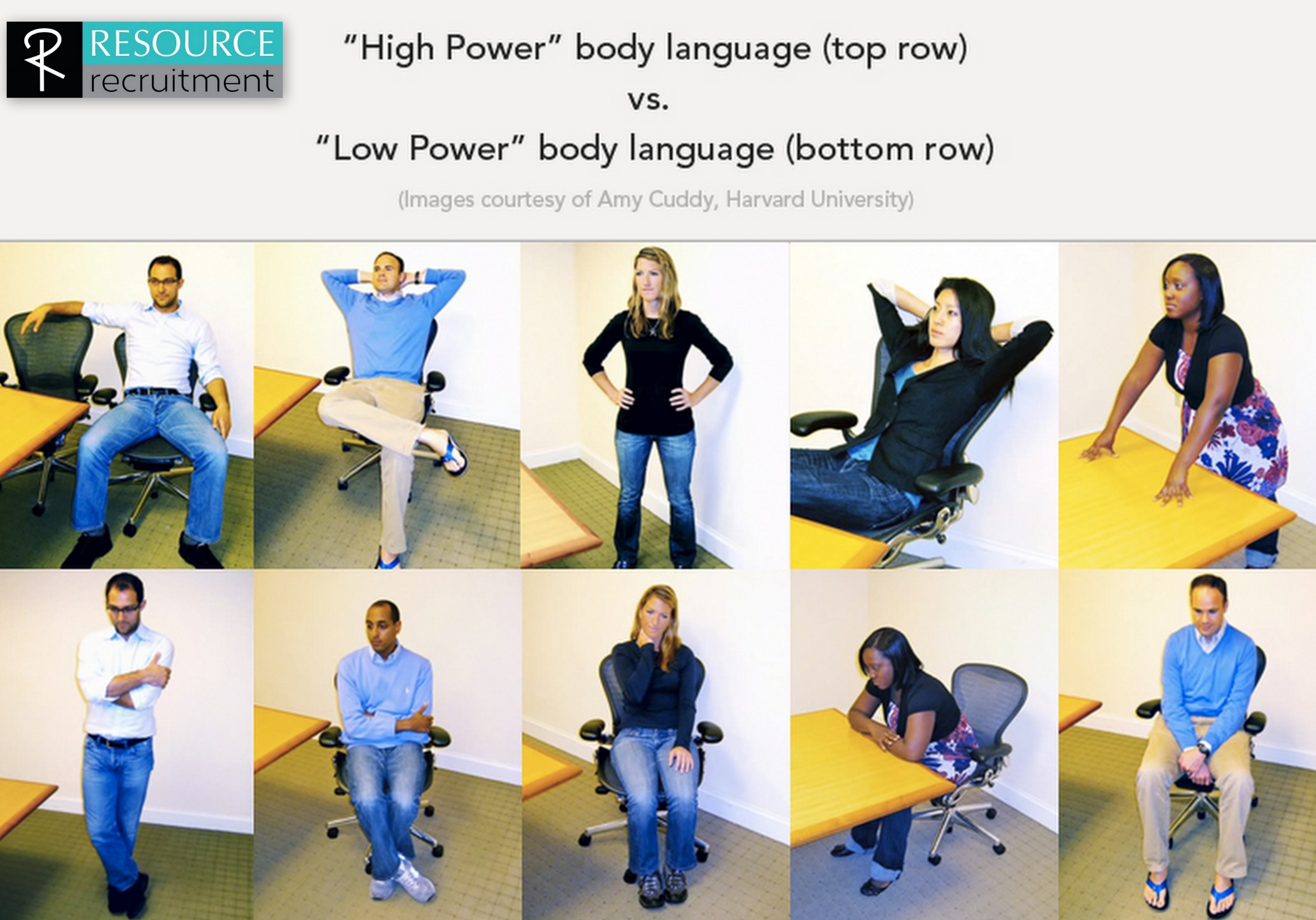
Examples of High and Low Power Poses

Power Poses involve stretching the body to take up more space and appear more powerful.  Take a minute to stand up, feet slightly apart, hands on hips, shoulders back and chin slightly raised.  Or lean forward and put your hands on the desk, placed wider than your shoulders.  I am sure that you immediately feel the power shift if you have been sitting hunched over your computer or desk.


If you have 15 minutes to spare, and want to find out more, I would strongly recommend that you follow the link and watch Amy Cuddy explain power poses, give examples of various poses and show you how you can “Fake it until you Become it” (https://www.ted.com/talks/amy_cuddy_your_body_language_shapes_who_you_are) !  This article also elaborates more on 8 power poses for work, has some great pictures to illustrate the point. (http://www.businessinsider.com/power-poses-interview-body-language-2014-3 )


It’s the little changes that we make in life, that often have the biggest impact.  So, before your next interview, don’t sit in reception making yourself as small as possible.  Sit up straight, shoulders back, chin up and arms open; or take two minutes in the bathroom or parking lot before the interview, in a power pose.


Empower yourself so that when you leave the next interview, you know that you have showed the best there is of you, and made the best possible first impression!

peanut


The Corporate Jungle Gym

Looking for a job is like climbing a Jungle Gym, not a rickety, old ladder.


Years ago, you finished school, hopefully got a tertiary education and got a job.  Either the job was because of your qualification, or it was because of a friend or family member.  Then you stayed in that job for as long as possible, hopefully climbing the corporate ladder, one rung after the other, until you retired.


We don’t live in that world anymore, and if anything, COVID has completely toppled the ladder.


Today, looking for a job is like climbing a Jungle Gym.  Sometimes you have to take a sidestep, or a step down to get to another section, that you may want to climb.  New jobs and industries are emerging constantly, and what you studied may have nothing to do with the job you are offered.  Chances are the job that you were doing 6 months ago, looks nothing like the job you are doing today, or the job will do in 6 months’ time; which means that if you apply for and accept a job today, you have to be open to it evolving over the next year. (This is particularly true now, when companies are employing during social distancing and with COVID restrictions, which will not be in place forever).


This is what you need to know to succeed on the Corporate Jungle Gym:-

  • You need to be an out of the box thinker who looks for opportunity.

Research is showing the promotions & opportunities are going to those that ask for them and go the extra mile.

  • You need to be innovative & confident to tackle the unknown.

Skills are being sought every day in companies, that were never needed before.  Volunteer to take on the assignment, and you may just make it your new career.

  • You need to be a solutions finder, not a complainer.

At the pace business is moving, no one has time for complainers, or employees who are inflexible and want to stay on the ladder.  We need solution finders to take us further, and figure out the next step.

  • You need to be a good communicator.

Today, more than ever, communication skills and attitude are essential.  Business is rapidly evolving, moving to online platforms and remote working, and this increases the demand for good managers, and team players, more than decreases it.  You need to ensure that your social media, email and WhatsApp communication is as professional and effective, as if you were sitting across the table from the other person.

.

If you have been forced into the job market unexpectedly, or you are a graduate hoping to get that dream job in your field of study, you may have to change your perspective and expectations.  This does not mean that you will jump into a whole new career, but rather than you may just need to be a little more open minded.


The good news is that, you now have permission to set your sights on new & different opportunities that you may have never considered before.  To build on your hobbies, interests & passions; not just your skills, work experience & qualifications.


This Jungle Gym has potential to offer more fun to you than you ever dreamed!

Daily Guide to Preparing your CV

Are you in the situation where you need to get your CV together and start applying for jobs, but you don’t know where to start and are procrastinating and doing everything else? Are you worried that the people in your life think that you are lazy, but in reality, you are just overwhelmed?  Where do you even begin to put together a CV, and tackle such an important task as finding a job?

Easy- one day at a time!

We have broken down this overwhelming task, into seven easy, manageable steps.  Don’t overthink it, just start putting your CV together today!

Day One: Get a template

Start with a fresh new template.  Keep it simple and professional.  It does not have to be 2 pages, a 4-5-page CV is quite acceptable.  It’s important that your template has enough space to include all your duties and experience, rather than just look pretty.  Visit our website to download our free CV template, or have a look at the templates in MS Word and CANVA

Day Two: Data Capture the Easy Stuff

It’s a big scary blank document, so start by just data capturing the easy stuff such as your personal details, computer systems worked on, educational details and an overview of the companies you have worked for, with the most recent first.  By the time you are finished with the easy stuff, it won’t seem so overwhelming to fill in the blanks!

Day Three: Check the dates

You are going to be asked what dates you worked for at your different companies and these dates will need to correspond with your reference, LinkedIn profiles and your reasons for leaving. So, you might as well take a few minutes now to make sure they are in your CV and that they are all correct.

Day Four: Brainstorm all the duties

In the olden days, you had a two-page CV because job applications were faxed.  Today you upload them onto job portals and these CV’s are shortlisted by being “searched” for with keywords. To ensure that your CV appears in these searches you have to make sure that you list all your relevant duties. If it’s not on your CV- you never did it, and you won’t be shortlisted for the job.  If you don’t have a job description or a list of duties, start by brainstorming what a typical day was like.  Jot down the information in point form and put as much information down as you can.  You can always go back and group and edit duties.  Don’t assume that everyone knows what you do and where possible avoid using abbreviations.

Day Five: References & Background checks

Once you send your CV off a lot of companies will proceed with reference checks and background checks.  Put the managers that you would like contacted with the company details as well as their contact numbers on your CV.  It is also a good idea to let them know that you are putting them down as a reference.  At this point, you will also want to check your privacy settings on your social media accounts and make sure that your LinkedIn profile, mirrors your CV.

Day Six: Proofread

You should be trying to impress with your CV, so it should be an example of the best work that you can produce.  If it is littered with spelling and grammar errors, it won’t make a good impression.  Ask someone to read it over and check for mistakes. However, be careful of giving it to someone who wants to appear as professional and give unwanted advice.

Day Seven: Checklist

Make sure that your CV has the following: Your contact telephone number; Email address; The area and region that you live and can work; If you have your drivers licence and own car; How soon you can start a new position; Your ID number; And what computer packages you have worked on.

Your CV is a constantly developing portfolio of your experience, and as such, should never be a final copy.  Once you have a CV, start sending it out and applying for jobs.  As you get feedback from recruiters or realize that something is missing, alter and update it.

Be Mindful

It’s a stressful time for everyone.  This situation that we find ourselves in is completely unprecedented, and the unknown the future holds just amplified that stress.  It is so hard to not completely panic and be crippled by anxiety, but you have to stay mindful and keep focused. 

If you are a job seeker, it is especially important that you stay mindful and focus on your goals.  Often job seekers appear to be procrastinating about getting their CV together, applying for jobs,  and the process in general, when in reality, they are just overwhelmed by the process.  It’s scary, and if you lose perspective, it can be hard to know where to even start!

Here are a few things that may help you gain some control over the situation:

Mourn the loss

People resist change because they are mourning the loss of what was.  It’s okay to mourn.  It’s okay to look back on a job you loved, or a dream you have let go of.  The second you acknowledge that you are mourning the loss of what could have been, or was, you are able to start moving forward and embrace the opportunity that today holds. 

Start looking for joy

I am a big fan of gratitude journals.  But these can get boring and a little stale if you are not feeling very grateful at the moment.  Try looking at things differently and look for joy.  The joy you feel waking up to the sound of rain or the birds chirping.  The joy you feel having the time to watch TV or read a book.  The joy of a hug from a loved one.  And if it does not bring you joy- like scrolling through social media feeds about the state of the world- stop!  Focusing on joy or gratitude slowly makes you more positive, and positivity attracts more positivity.

Set yourself goals and hold yourself accountable

The job-seeking process can be broken down into a number of little steps, which approached systematically, makes the whole process a lot more manageable.  Furthermore, it’s a constantly evolving process- so don’t put too much pressure on yourself to get it right the first time.    You will do a CV, and then get feedback on it and need to add information.  You will not be shortlisted for a job, and then know the way you apply needs to change.  You will mess up answering an interview question, and then know how better to approach it the next time. 

Focusing on “getting the job” is getting ahead of yourself.  Focus rather on what kind of job you want, and then putting a cv together, then loading your details onto job portals, and then searching and applying for jobs, and then….

Make a list (write it down!) of what you need to do, then set yourself a goal for today, this week, this month.  Maybe today you are going to call someone and bounce ideas off them as to what job you should apply for (you don’t need to know the exact job title).  Then tomorrow draw up a CV- it’s as simple as data capturing your details info a template, and then reviewing it.  Maybe set yourself the goal of loading your CV onto a job portal every day.  Break the process down into bite-size pieces, and just look at the next piece, not the end goal. 

Activity attracts activity, and you will find that as soon as you start moving the process forward, things will start to fall into place.

Manage your time and skills

There are things that we cannot control, but there are plenty of more things that we can control.  You can control your time, and schedule time into your day to be still: exercise, look for a job, and improve your skills.  There are so many free resources out there at the moment, that you get to chose if you leave this time of being at home with new skills… or waste your days away.  When you are asked at your next interview, “What did you take away from the COVID19 shutdown?” or “How did you manage your time during the shutdown?” – how will you answer?

Here are just a few of the many resources available to you:

www.udemy.com  
www.coursera.org  
www.getsmarter.com  
www.udacity.com  
www.skillshare.com

https://thehollisco.com/pages/next90

There are also some great YouTube channels, podcasts and books to read or listen to.  If you have stumbled across a great site- set us know, so we can share it with other job seekers. 

Keep perspective

This will pass- it always does.  Times are tough, and they may get tougher… or they may not. And next year will most definitely bring a new set of achievements and problems; as will the following- that’s life.  Worrying about what will happen at the end of the month, or next month, does nothing to help you, it just makes you anxious and overwhelmed.  There may be retrenchments and jobs lost, but that does not mean that you will be unemployed or lose your job.  As long as there is a country and people living in it, there will be jobs.  If you want one of those jobs, you need to be present in this moment, and embrace this exciting new time as an opportunity.

Keep an eye out on our social media accounts (@resource_recruitment) and our website (www.2r.co.za) for more newsletters that will be coming out, on how to figure out what jobs you should apply for; how to draw up a CV; tips on getting the most out of job portals; your LinkedIn Profile; and so much more! 


Let’s Chat

The world is changing and so is the way we do business.  2020 has seen businesses globally, from big to small, being given the “virtual shove” into changing the way that they do things- working remotely and communicating electronically.


Since the day I opened RESOURCE recruitment almost 20 years ago, we have prided ourselves on being leaders in e- recruitment. With a Facebook Following of over 20 000 job seekers, almost 10 000 connections on LinkedIn and a Bulk Mailer of 35000 active job seekers (in addition to the regular online portals most employment agencies use), we have a very big digital footprint.  All that being said, I have always been adamant (and still am) that we need to maintain the human connection and personally meet our clients and candidates, get to know their businesses and them as people, and not be tempted into communicating exclusively electronically.

But, 2020 has had different ideas for me, and I am being forced to grow and evolve and embrace video meetings like Skype and WhatsApp Video Calls.

Here are some tips that I have researched that will help you prepare and ace your next video job interview!

  1. Dress to impress
    It is so tempting to not dress up for your interview, if you are sitting at home in casual wear.  There are two reasons why you should dress to impress.  The most important is the way that it makes you feel when you power dress in a smart outfit, versus the t-shirt you were going to wear.  The second is that research shows that on video job interviews, the details are amplified.  The person on the other side of the camera is more likely to notice your makeup, earrings and nail polish; than a person would face to face.  I have also read that shades of blue, black and white are the best colours to wear, because red, orange, yellow does not always appear good to other screens.


  1. Avoid interruptions

Most important- PICK A QUIET SPOT WITHOUT INTERRUPTIONS.  Tell people that you are having a video meeting and that you cannot be interrupted.  If you can, lock the door so that no one walks in mid-meeting.  Personally, when I have tried to have a conversation with someone and there is a child screaming, or what feels like a party going on in their background, and I am battling to hear them, I get irritated at the lack of respect and professionalism that they are showing.  I can also only imagine how distracted they are feeling.


  1. Prepare your surroundings
    In a traditional interview, you are going to a company, or inviting them into your meeting room.  But on video interviews, you may be inviting them into your home.  Make sure that your backdrop is neat, uncluttered and does not reveal too much about you personally.  Be authentic.  I once had someone send me a video interview with some motivational books strategically placed on their desk to impress.  When I asked about their opinions on them, it was clear they had never even read them!


  1. Close other programs on your computer.
    Getting notifications during your interview is distracting and unprofessional. Before your interview, make sure all other windows on your computer are closed (especially if they make a noise).


  1. Look at the camera, not the screen.
    It is very tempting to watch yourself or your interviewer during a video session but looking directly at the video camera is the only way to maintain direct eye contact with your interviewer.


  1. Use notes, but not too many
    Don’t be afraid to help yourself with post-it notes or a copy of your resume handy when you interview. A benefit of having a video interview is that you can have a cheat sheet in front of you so that you don’t have to memorize everything and can keep your focus. However, avoid having scripts written out and being so concerned about the notes that you disrupt the flow and human connection of the interview by awkward pauses and papers flapping.


  1. Keep your profile professional.
    Unlike face-to-face interviews where your first impression is made by arriving well-presented and smiling as you shake someone’s hand, when you do a video interview it is different. The first impression is your profile, your username and your picture and before the call even clicks through you have made an impression. If your profile is not professional- create a new one.


  1. Watch your body language.
    Sit up straight, but keep your shoulders relaxed.  Chose a desk chair over a comfy couch.  Try not to fuss with your hair or fiddle with things on your desk.


  1. Practise makes perfect.
    The job interview itself or meeting is not the time to test the audio settings and internet connection and if your Skype is working.  Do that beforehand.  Video call some friends and ask them how you look, what the background looks like, and how they can hear you.  Get comfortable with seeing yourself as you talk to someone, and not getting distracted by that image, while you make a connection.


  1. Stay connected and engaged
    It’s easy to lose the connection with the person on the other side of the screen when you are talking too much, or not to notice when their interest has been lost.  Try have a two-sided conversation, rather than launch into long speeches.


This is new to us too, so we would love to hear any hint, tips and hacks you may have for video interviews or any experiences that you would like to share.

How to avoid an employment scam

It was recently brought to our attention that one of our candidates had been victim to one of the latest recruitment scams. In light of this we wanted to inform you of the ways to recognise these scams and how to prevent it from happening to you.


  1. You are offered the position outright without ever having gone for an interview or having spoken to a person on the phone. If you receive an email that says you have been offered the job with a start date- but no company name or profile, this is a red flag. No company will realistically employ you off your CV alone, never having met you.


  1. There is a monetary transfer involved. In South Africa it is prohibited by law to charge someone to find them a job. The second that someone asks you for money, without ever having met you, we would advise you to think twice!  This includes payment of registration fees or background checks.  


  1. Look at the email address and website – are they legitimate? The one way of telling if it is a fake site or address, is to look critically at the email or website address- not just the display name that they are using. If they have used a made-up company name or number, Google them and do some research. Does the website look roughly put together and not professional? When you search their details do multiple sites come up referring to them or is it just the one site that they have created? If it is genuine company they will have a footprint and presence on the web.


  1. What do the documents they send you look like? Are they professional with a letterhead and logo? If not, I would start to question it. If they have provided you with contact details try and get hold of them and ask to speak to their HR department. If there are only cell phone numbers provided, see if you can get a landline number.


  1. They refer you to a second party that will do the background checks. There is a new scam were they refer you to a second party for background checks, but the second party is part of the scam, and once you pay your money, the job and company cease to exist. 


  1. Lastly, if you have fallen victim to one of these scams – don’t beat yourself up or feel ashamed, they are designed in such a way that they know how to get money out of you. By targeting job seekers, they know that their target market is one that is desperate and it is in this desperation that we sometimes don’t always make the most rational decisions – it’s part of being human. The best thing you can do going forward is to speak up and to make people around you aware of how you were scammed. Alert people to the names of the companies who scammed you so you can bring more awareness to how these scammers are operating.


If you have ever been scammed by a fake recruitment agency, get in touch- we want to hear your story: chrissi@2r.co.za . Also, feel free to let us know if you have any other hints and tips you can pass on – the more light we shed on this subject the better. 


Article by Chrissi Preuss, Psychology (Hons.) – February 2020


CV Fraud Punishable by Law

In August 2019 an Amendment to the National Qualifications Framework Act was gazetted, which will have a direct impact on job seekers and employers.  Among other things, the act makes direct mention of job applicants and employees misrepresenting themselves on their CV’s and job applications, and such misrepresentation may be punishable by fine and/ or imprisonment.


Below is a summary of what the amendment says with regards to this.  If you would like a copy of the amendment, please feel free to email us or visit the department of labours website (www.labour.gov.za)


A person will be deemed guilty of an offense if:-

  • A person makes or causes to be made a false entry in the national learners’ records database; is a party to the falsification of; or with a fraudulent purpose, knowingly provided false or misleading.
  • A person or training provider is guilty of an offence if they claim to be offering a qualification or part qualification registered on the NQF whereas that qualification or part qualification is not so registered.
  • A person is guilty of an offence, if they falsely or fraudulently claims to be holding a qualification or part-qualification registered on the NQF or awarded by an education institution or obtained from a lawfully recognised foreign institution.
  • Any person or training institution is guilty of an offence if it falsely claims to be registered and accredited as an education institution.

If a person or training institution is convicted of any offence under this Act, the court that imposes the sentence shall consider as an aggravating factor the fact that the offence was—

  • committed with the intent to gain financially, or to receive any favour, benefit, reward, compensation or any other advantage; or
  • gained financially, or received any favour, benefit, reward, compensation or any other advantage.

Any person convicted of an offence in terms of this Act, is liable to a fine or to imprisonment for a period not exceeding five years, or to both fine and such imprisonment.

The National Minimum Wage Act


The National Minimum Wage Act

As of January 2019, the first ever National Minimum Wage Act came into effect, and while most employers have embraced this initiative, we thought that we would give you a summary to re-cap.


What is the rate?

The legislation stipulates a minimum national rate of R20 per hour, or R3 500 per month, depending on the number of hours worked.

The R20 an hour rate will be phased in slowly in the agriculture and domestic work sectors, with workers earning R18 and R15 per hour respectively.  Employees who are on volunteer programs or learnerships are exempt from the act.

This means

DAILY MINIMUM WAGE         R20 x 8 hours = R160  or R20 x 9 hours = R180

WEEKLY MINIMUM WAGE     R20 x 40 hours = R800 or R20 x 45 hours = R900

MONTHLY MINIMUM WAGE R800 x 4.333 = R3 466.40 or R900 x 4.333 = R3 899.70


Employees are also entitled to be paid for a minimum of 4 hours, even if they work fewer.

Allowances that make an employee able to work such as tools; equipment; transportation and accommodation) will have these allocations included when calculating their wage; as will bonuses, incentives, tips and gifts be excluded from the minimum wage.

No employee may make deductions in excess of 25% of the employee’s remuneration.


When did it become law?

 The National Minimum Wage will be applicable and enforced as from 1 January 2019


What happens if you do not pay the minimum wage of R20.00 an hour?

The minimum wage is law, so if you do not pay it, your staff can report you to the department of labour or the CCMA.  Even if your staff agree to work for less, or to get paid for fewer hours than four hours, they are still legally entitled to it, as it falls under the Basic Conditions of Employment Act.

The Act does allow for an employer to make an application to be exempt from paying the minimum wage, for not longer than one year.


When will the Minimum Wage Increase?

The Act states that the minimum wage must be reviewed after 18 months and increases in two years.  The review will specifically take into account inflation, productivity, the effect on employment and businesses ability to cope with the increase in wage expenses.


If you would like a copy of the National Minimum Wage Act, you can obtain one from the Department of Labour’s Website.  (http://www.labour.gov.za/DOL/legislation/acts/national-minimum-wage/national-minimum-wage)