Interview Nerves

Believe it or not, interview nerves are not all that bad!
Nerves often come when our sympathetic nervous system is activated- that fight or flight response that was designed to keep us safe from danger. In an interview, if our sympathetic nervous system is activated, your responses are heightened to help you perform better and deal with the stress. If you have that nervous/ adrenalin rush too early, you can find by the time the interview starts, you are dull and your answers are flat. Just being aware of this, can help you to consciously “dial up the energy”. The opposite is also true- when your sympathetic nervous system is over stimulated by nerves, and you are unable to settle and focus.
Whether you are feeling flat or overly anxious, I find the best solution on the way to the interview, is to sing and dance. Turn up the music and sing along at the top of your lungs (or just imagine you are 😊). Dance a little in your car seat. Burn off some of that nervous energy (or build up a little energy- whichever you need). I promise you will feel better!
Remember, those nerves- they are going to make you perform at your best!
Embrace them, don’t view them as an obstacle.


Virtual Interviewing Tips & Tricks!

Whether you’re applying to be the receptionist at a dental practice or the CEO of a major company, its no doubt that we all get just a little bit nervous when it comes to the interview. For many jobseekers, going for an interview is one of the most intimidating steps in the process of getting a job.  Because of Covid 19, many companies have made use of virtual interviewing, which will likely continue to be an option for years to come. Virtual interviews are a convenient way of meeting and interviewing applicants “face to face”, however, not everyone is comfortable with this platform. Even though you cannot greet your potential employer/recruiter with a firm handshake, there are still a few ways in which to make a good first impression from behind the screen.

Follow our guide below on how to prepare and perfect your video interviewing skills!

  • Keep your phone, laptop or computer at eye level. You do not want to be turning your chin upwards to see the camera or looking down. It looks unprofessional, and it’s unflattering too! When the camera is at eye level, you will feel more comfortable and natural during your interview!
  • Make sure to test your interviewing platform before the interview. If your interview is going to be on Teams, Zoom or a similar platform, test it out with a friend or family member to make sure that it is up and running smoothly, rather than having issues trying to connect when your interview is scheduled to start, and then running 10 minutes late.
  • Have a stable internet connection. The most frustrating part for any interviewer, is when the call keeps pausing or glitching due to poor internet. If you have poor signal, take a walk and find better signal before your interview.
  • Look at the camera. Make an effort to look at the actual camera in front of you instead of staring at yourself on the videocall. Don’t look around the room or avoid looking at the screen. It’s the closest you can get to ‘eye contact’.
  • Put your cellphone on silent. Phone calls and notifications are a distraction for you as well as for the interviewer and may throw you off your train of thought. Don’t glance over at your phone either!
  • Conduct your virtual interview in an environment where it is quiet, with little or no disruptions. If you’re at home, try to find a quiet spot – perhaps your bedroom or living room. If the environment around you is loud and distracting, you will not make the best impression and the interviewer will be distracted too.
  • Dress to impress! Yes, we know you’re probably sitting at home for this interview or in your car, but just because the meeting is virtual does not mean that normal interviewing etiquette goes out the window! Dress appropriately for the position you are applying for. (If you are doing the interview while at work and in a work uniform, that is totally understandable. But at least wash the grease off your check from the workshop beforehand!)
  • Don’t ramble! Your interviewer is NOT your therapist! Interviews are generally scheduled for a set amount of time – if you ramble on about something irrelevant for 20 minutes, your interview will be cut short without having discussed the important information.
  • Lighting is important. Make sure that you interview in an environment with good lighting. This is incredibly important and missed by many candidates. Your lighting should be natural (perhaps in front of a window, or even use a ring light if you have poor lighting) and should be coming from in front of your face and NOT from behind you! So many candidates interview with a window behind them, and then look like a silhouette the entire time. Rather turn around and face the window.
  • Staging is important. We understand that sometimes your surroundings are not ‘picture perfect’, but you can make your background look less cluttered and distracting in a few simple steps. If you’re interviewing from your bedroom – make sure that your bed is made in the background and pick up clothes from the floor (or from that one chair that we all use for cluttering things on!) or at least move it out of sight from the camera. A simple, neat background does wonders for your interview. Sitting in front of a clear wall with a plant behind/beside you is so simple, yet so effective!


Profile Pictures on CV’s

The latest trend in recruitment seems to be putting a photo of yourself on your CV.  The majority of the population hate having their photos taken, are naturally critical of themselves, and generally object to this.  I have to admit, if I was in your shoes, I would too!  But the reality is, that employers want these photos, so this may help you to understand why, and what your ideal photo should look like.


WHY PUT A PHOTO ON YOUR CV?

I cannot speak for every recruiter, and certainly I am sure that there are those people that are asking for photos for the wrong reasons.  RESOURCE recruitment does not ask for a photo when you apply for a job through us, but we take one at the interview, which we put on your CV that we will send to our clients.

Many people are visual, and it helped us remember the candidate, a year or two down the line.  Clients then started requesting photos.  When they are interviewing several people in one day, it helps to look back on the CV and photo, to recall and reflect on the interviews.  Clients will also phone us three months down the line, and say, “Remember we interviewed that lady for the sales position, and she was not suitable.  Well another position has opened up, that she would be perfect for!  She was the one with the really cool afro.”  A glance at a photo, and they know they have the right person.


But probably the most important reason for putting a photo on your CV is that it makes your CV personal.  It makes a piece of paper, a person.  The candidates getting short listed, are the ones with pictures on their CV, it is not because of their good looks!  A few years ago we placed a senior bookkeeper.  All the applicants happened to be between 55 and 59 years of age.  One of the applicants did not want a photo taken for their CV (which we respect).  When the client short listed candidates for interviews, he asked to see all the candidates except the one without a photo.  When I asked him why he did not want to see her, he replied, “I don’t know.  I don’t get a good feeling about her CV.  Let’s see the others first.”


THE DO’S AND DON’T’S OF PROFILE PICTURES

Here are a few common mistakes to watch out for when putting a profile picture on your CV.  Always remember the aim- to market yourself as a professional, not to win admirers and friends.

Blurry or Too Small

Ideally your photo should be 200 x 200 pixels or larger. Anything smaller and you’re guaranteed to end up with a fuzzy or teeny tiny image If possible chose a square head shot, as it will work with other social media accounts.

Too Close or Too Far Away

Stick with a standard head shot for your profile pic. Prospective employers won’t be able to identify you from a picture too far away.

The Group Shot

Remember, this picture is supposed to represent your professional brand – no one else’s. Don’t make recruiters guess which person you are in the photo. Use an image that shows you and only you.

The Crop

Cropping yourself out of the group shot doesn’t work either. While it may be your favorite picture, no one wants to see half of your loved one’s face or your best friend’s hair on your shoulder.

Too Serious

Opt for photos where you’re looking at the camera and smiling. You want to appear friendly and approachable.

Goofy Expressions

Remember, this image is supposed to represent your professional brand. When you look at your profile photo, does it send the same message as your resume?  This includes NO pouty lips!!

No props, baby pics and pets.

Save these cute pics with your toddler or puppy for your personal social-media channels such as Facebook or Instagram. Make sure that you are not holding alcohol or cigarettes, and that you don’t have any props in the picture indicating that you are off to do something, such as a motor bike helmet or fishing rod.  Stick to a photo of yourself for your professional profiles.

No Selfies

This is a professional photo of you.  Ask someone to take it, rather that have your hand shooting out the corner of the photo.

Backgrounds Count

Before you put a photo of you in a nightclub, or most commonly a bathroom, think about the impression this makes.  Either a neutral background is good, or alternatively at your desk or in a professional setting is always good.

Dress to impress

Dress in appropriate work clothes.  No evening dresses, wedding gowns, bikini tops, topless men or sky diving suites if you want to be taken seriously.


It’s totally up to you if you put a picture on your CV or not, but if you are going to, make sure that like all things when looking for a new job, it markets you the way you want to be viewed by prospective employees.


If you are Applying for more than one Type of Job, Have More than one CV.

Looking for a employment is a sales job.  It’s all about marketing your CV to potential employers, looking for opportunities, building your brand.  Whether you fancy yourself as a sales rep or not- tough- now is the time to learn how to sell.


And the first thing that you have to do, is get your brochure (CV) professionally and appropriately drawn up!


If you decide that you are a secretary and would happily be a secretary, but would equally like the idea of getting into Events/ PRO or Sales Coordination position, because you have already done a bit of this, then you need to have a cv that sells you for each line of work.   Similarly, you may be a draughtsman who is keen to also try mechanical engineering or technical sales.


The first page of your CV will remain the same for all the jobs you apply for.  This will contain your personal information, contact details and ideally a professional photograph of you.


The second page will contain your computer skills and education.  Here you will list the skills most relevant to the job you are apply for first, and in more detail than the less relevant qualifications.  It’s often a matter of just switching the order around.  But the person reading your CV will assign the most importance to the skills they read first and that dominates the page.  For example- you are a draughtsman applying for a technical sales position as well.  When you apply for the draughtsman jobs, the Dale Carnegie course is not really that relevant and would be at the bottom of the skills section, if there at all.  But if you are applying for a technical sales job, putting this first, immediately gives the impression you have people skills.


The next section is the career history.  Always start with the most recent job first, and put dates and duties.  But the duties that are relevant to the position you are applying for, should appear first, and in more detail.  A good example is that you are an Office Administrator/ General Accounts Clerk.  You want to apply for a debtor’s position.  You need to take your debtors duties and put them as the first duties under that place of employment.  You may have just written “Debtors” as one of many points.  Now you need to elaborate.  What is the size of your debtor’s book and how many accounts do you handle?  Do you do invoicing and statements? Do you phone for money? Do you allocate payments off the bank statement? Do you deal with debtors queries?  If the first 5 points listed under duties are debtors, even though after that are a bunch of other unrelated duties, you have still made the impression that you are a debtor’s clerk!


Finally, if you don’t have a lot of skills and experience in the area that you are applying, but it is your passion and you know a lot about it through your hobbies and research, then add this in.  If at all possible, include it under the career section and give examples of your work.  Maybe you designed a website in your own time to market your wife’s business?  Or you do your husbands bookkeeping in the evenings?  Or you won a quilting competition and you want to get into the textile industry.


When I look at your CV, and you are applying for a particular position, your CV needs to give the overall impression that you are suitable for that position.


But… never lie and misrepresent yourself.  You can promote and emphasise why you are suitable, but don’t ever lie.  One lie will discredit your whole CV.


Finally, The Golden Rule:- “If it’s not on your CV, you never did it.”

Getting Feedback on your Applications

GETTING FEEDBACK ON YOUR APPLICATIONS


Not getting feedback when you apply for jobs can be so frustrating and demotivating!  But, instead of being powerless in the job seeking process, why not  be more proactive with your communication and take control of the feedback process as much as you can?  Here are a few tips that may help you take control of the situation:-


The ability to communicate effectively and professionally at all levels, is a skills that all businesses seek.  It’s one of the first things that is assessed in interviews. You can be a genius, but if you can’t communicate, no one will ever know!  How you communicate before you even get the interview, and during the interview and shortlisting process, can make all the difference at the end of the day!

Listening & Interpreting Information
Being a good listener is one of the best ways to be a good communicator. No one likes communicating with someone who only cares about putting in her two cents, and does not take the time to listen to the other person.

Sometimes, recruiters put specific requirements on how to apply for a vacancy.  There are many reasons why they will do this, but failure to follow the instructions, will ensure that you start the process on a negative note.  If the application asks for CV’s to be emailed, faxed or posted- use this means to deliver your application.  And if they ask for a covering letter or supporting documentation (or none at all) – listen to the instructions.  If you are not communicating in the way they want, they may reject your application, without you even knowing, and this is the reason you are not being contacted for interviews.

Keep it short and to the point!
Good communication means saying just enough – don’t say too little or talk too much. Try to convey your message in as few words as possible. Say what you want clearly and directly, whether you’re speaking to someone in person, on the phone, or via email. If you ramble on, your listener will either tune you out or will be unsure of exactly what you want. Think about what you want to say before you say it; this will help you to avoid talking excessively and/or confusing your audience. Often people talk themselves out of a job. Nerves kick in and they start talking and just can’t stop and end up telling way more than they should.  Keep it short and sweet, and remember this is a professional exchange, not a friendly chat!

Friendliness
People like happy, friendly people. The effort it takes to smile, be friendly and patient; will be the best investment you can make when looking for a job. I know that you will get frustrated and irritated with the process, everyone does, but avoid making a phone call when you are in a negative mood, and check the tone of your email.

Be aware that when you get negative, stand your ground and confront a potential employer or recruiter, you may make your point, but chances are you will not get the job.  Always be assertive in a constructive, positive manner!


Picking the Right Medium
An important communication skill is to simply know what form of communication to use.

Initially, always follow the medium that the advert asks for the application.  This shows that you respect their process and can follow instruction.  If it is not stated, always apply in writing, via email.  Attached your CV and anything that is requested, but at the initial stage, avoid attaching lots of supporting documents.  Try and make the recruiter’s job as simple as possible.

From this point, you need to get the balance right- when it is appropriate to continue on email, phone or maybe even pop in to see the recruiter.  Too many phone calls or an unsolicited visit, may be inappropriate, but there is a lot to be said for picking up the phone.  (But never let anyone else phone on your behalf!!)

Feedback
And the most important bit of advice from this newsletter- ASK FOR FEEDBACK! As demotivating as it may be, it is a reality that you are one of hundreds of people applying for a position, and there is often just one person going through the CV’s and the process. If you want feedback you need to pick up the phone or send an email.  Not only will this give you constructive feedback on where your CV or skills may be lacking, but it is an opportunity to build relationships with the recruiter.  Knowledge is power, and knowing why you have not been short listed, can be extremely motivating (as strange as that may seem!).  If you have not passed the email stage of applying, then forward your original application, and ask for feedback (don’t make the recruiter go looking for your application).  If you have been in for a personal interview, then pick up the phone and start building relationships.

Relationships are a two way street, so don’t apply for a job and then wait to get a phone call.  Be proactive, and drive the process!  Start interacting with your recruiter, and I promise, you will be at the top of their minds next time a job comes in, and they will start communicating back!


Tips for Looking for a Job Online

10 TIPS TO LOOKING FOR JOBS ONLINE


Along with all things, how we look for jobs is changing rapidly every year, and in just the last 10-15 years the recruitment industry has moved almost completely from advertising in newspapers and receiving paper (fax, posted or delivered CV’s), to advertising electronically and receiving digital CV’s either via email or uploaded onto websites.  The industry is changing so rapidly, that a lot of schools have no even started teaching school leavers about job portals, and if you are new to the job market after being away for a while, you may find it quite daunting!

Hopefully, these tips will help you navigate looking for a job on line a little easier.

  1. Be careful who you ask for advice

Everyone is an expert!  Everyone likes to tell you what you are doing wrong, and what you can change (even if it does not need to be changed).  You can ask parents and grandparents for assistance and guidance in your education, maybe dealing with your boss and how to resign.  But when it comes to preparing a CV or posting your applications online, unless they currently are responsible for recruiting staff, they may not be the experts to turn to.

  1. Use reputable websites or job portals

There are a lot of job portals out there that take adverts off other websites, and place it on their websites to drive clicks/ traffic to their websites.  These are not the websites that you want to be visiting because often the jobs you are viewing are outdated or invalid.  You want to be using websites where the advertiser placed the job themselves, has the correct email address for responses and a deadline for the advert.  RESOURCE recruitment always keeps their jobs updated at https://2r.co.za/category/vacancies/ .  Other good websites to keep an eye on are Pnet, Careers24, Career Junction, IOL and Gumtree.

  1. Make sure the KEY WORDS are in your CV.

When I search for a suitable applicant among CV’s, I use “Key Words” to find applicants with the required skills.  This means that if those skills (key words) are not on your CV, you never did it (even if you did), and you won’t be short listed.  Keywords would be, depending on the job requirements, things like- Pastel, Syspro, reconciliation, VAT, balance sheet reconciliations, statutory returns, payroll and Forex for a bookkeeping position; or litigation, conveyancing, Dictaphone typing, minute taking and paralegal for a legal secretary position.  Think about what job or industry you are wanting to get into, and then make sure these words appear on your CV

  1. Avoid abbreviations

Don’t assume that the person reading your CV will know your industry abbreviations and lingo.

  1. Fill out the registration form in full

I know that it is time consuming to do this when it is all on your CV, and you have probably filled out a hundred forms similar to do this before, but it is important.  Remember, “If it’s not on your CV you never did it”, so “If it’s not on the application form, you also never did it!”  (If the company then sends you another application form to fill out, you need to complete this form too.)  Recruiters are going through literally hundreds of applicants, 80% of which are totally unsuitable, and these application forms from the companies are created to streamline the short listing process.

  1. Keep your CV Updated

This is normally the main reason that the most suitable applicants are NOT short listed.  Their CV is not updated to show their latest experience; that they now live in the specified area; that they now have a car; that they have completed a qualification; or that they are available immediately.

  1. Put your email address on your CV

It stands to reason that if you are applying for a job online, you should have your email address on your CV in addition to your phone numbers.  And don’t forget to check that email address daily!  If your CV is forwarded to someone else in the company, saved or printed- it may be separated from your original email.  (And we should not have to say it- but remember your phone number too!)

  1. Social Media Accounts

If you are applying online, chances are that the recruiter will google you, or more accurately- Facebook- stalk you!  If you have not put your privacy settings on your social media accounts, you are inviting them into your personal lives.  Do you want to be judged on your political views and what you did last Saturday night; or that you are home from work again with a sick baby; or that all your posts are made during business hours?

LinkedIn is huge internationally, but it seems to be gaining popularity now in South Africa.  This is the “professional” version of Face Book.  This is the face you present to future employers and network.

  1. Get your CV out there

Looking for a job is a “stats game”.  The more people who have your CV, the sooner you will find something.  The more portals your CV is on, the more companies will view your CV.  The quicker you reply to emails requesting information or interviews, the more interviews you will attend.

  1. Keep your Account Current

The final tip is to keep your profile current on the portal.  Each month, go in and edit something.  It’s not important what you edit.  When I am searching for applicants, those that were active most recently will appear first, and those that were last active six months ago, I probably wont look at because, chances are, they have found something.  The job portal does not show when you registered, it shows when you were last active.


How to look and feel POWERFUL in your next interview… even if you are not on the inside.

We all know the importance of making a good first impression, and the importance of body language in doing this.  It’s probably the single biggest weakness we see in job seekers attending interviews- they often let nerves get the better of them, which translates through poor body language as a negative attitude or presence.

Here are a few common mistakes we see with body language:-

  • Poor posture- slouching (lazy), leaning forward (like you going to make a run for it) and leaning back (too casual), can all send the wrong message. Sit up straight, without being rigid and look alert and engaged.
  • Eye Contact- make eye contact, especially when shaking hands, but be careful to not stare too long or have fidgety eyes- constantly looking around- like your attention is elsewhere.
  • Keep your arms neutral- don’t cross them, hold them behind your back or put them in your pockets.
  • Don’t fidget and bounce. This is the most common.  Interview nerves bring out the bouncy leg, the itches and hair that constantly needs adjusting.  And this nervous energy is distracting the interviewer from what you are actually saying.

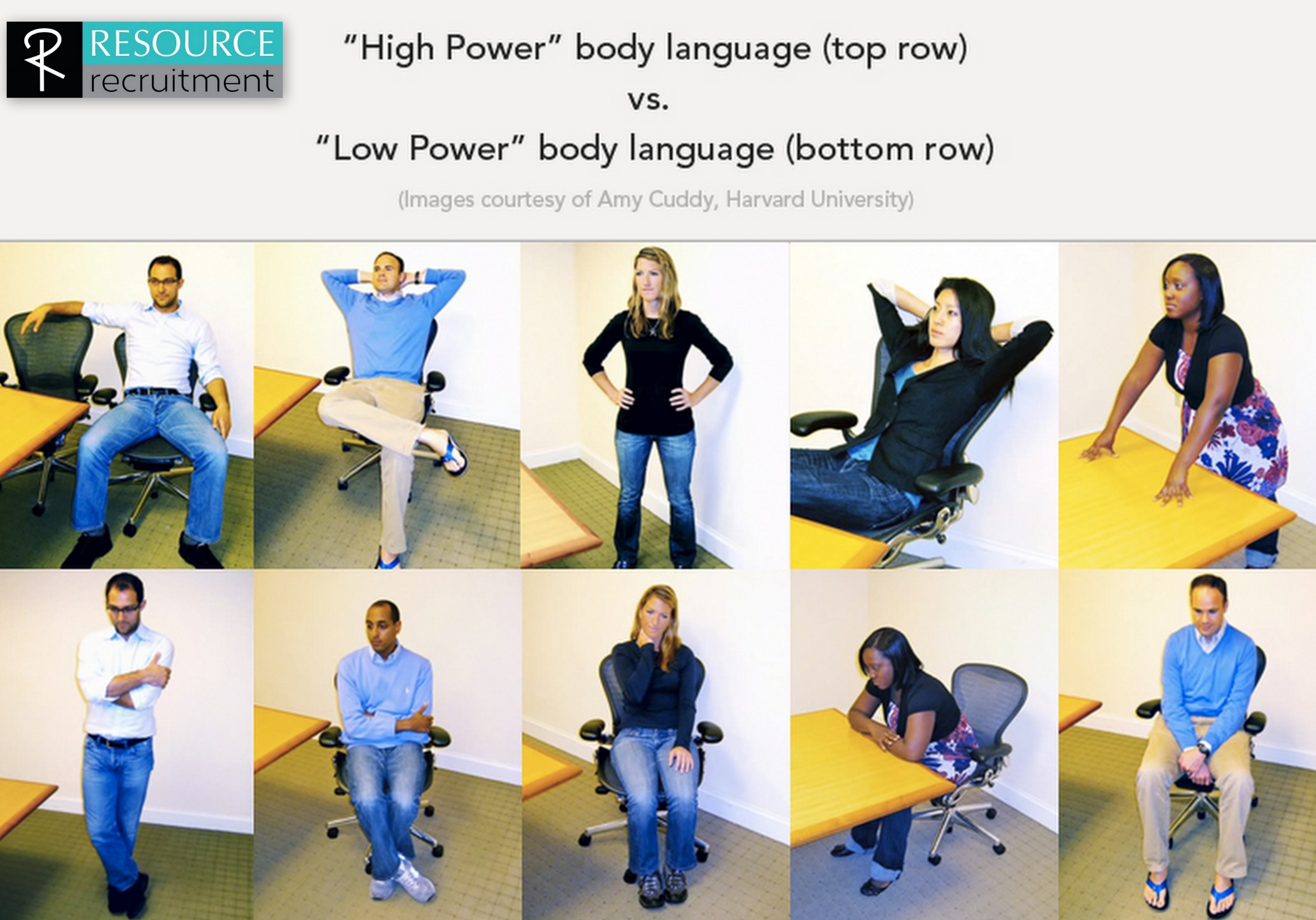
If poor body language can make us appear nervous, incapable, submissive, unconfident and negative, then what if the opposite was true?  What is we posed with the correct, empowering body language- would this make us feel and appear confident, positive, assertive and optimistic?  This is exactly what Amy Cuddy discovered in her research:-

Our minds may change our body (language),

but our body (language) can also change our minds!

Amy Cuddy researched one of life’s most simple tricks- Power Posing.  Power Posing is the act of taking a posture of confidence, even when you don’t feel confident, to make yourself more dominant.  (Its seen in nature with an ape banging his chest, a snake rises to attack and birds extend their wings and tail feathers to assert themselves.)  Her research showed that sitting or standing in a certain way, for as little as two minutes, raises testosterone levels and lowers stress hormones, and ultimately effects the way you interact with people.  Power Posing is especially beneficial when facing a “social threat” where you are being evaluated, such as negotiating deals, pitching ideas and job interviews.

Examples of High and Low Power Poses

Power Poses involve stretching the body to take up more space and appear more powerful.  Take a minute to stand up, feet slightly apart, hands on hips, shoulders back and chin slightly raised.  Or lean forward and put your hands on the desk, placed wider than your shoulders.  I am sure that you immediately feel the power shift if you have been sitting hunched over your computer or desk.


If you have 15 minutes to spare, and want to find out more, I would strongly recommend that you follow the link and watch Amy Cuddy explain power poses, give examples of various poses and show you how you can “Fake it until you Become it” (https://www.ted.com/talks/amy_cuddy_your_body_language_shapes_who_you_are) !  This article also elaborates more on 8 power poses for work, has some great pictures to illustrate the point. (http://www.businessinsider.com/power-poses-interview-body-language-2014-3 )


It’s the little changes that we make in life, that often have the biggest impact.  So, before your next interview, don’t sit in reception making yourself as small as possible.  Sit up straight, shoulders back, chin up and arms open; or take two minutes in the bathroom or parking lot before the interview, in a power pose.


Empower yourself so that when you leave the next interview, you know that you have showed the best there is of you, and made the best possible first impression!

peanut


Free CV Template

Your CV is your most important tool when job seeking, so ensure that you have the best CV possible with all the necessary information in order to make a great first impression.

Click the link below to download a free CV template: 

RESOURCE recruitment CV Document- Template

The Corporate Jungle Gym

Looking for a job is like climbing a Jungle Gym, not a rickety, old ladder.


Years ago, you finished school, hopefully got a tertiary education and got a job.  Either the job was because of your qualification, or it was because of a friend or family member.  Then you stayed in that job for as long as possible, hopefully climbing the corporate ladder, one rung after the other, until you retired.


We don’t live in that world anymore, and if anything, COVID has completely toppled the ladder.


Today, looking for a job is like climbing a Jungle Gym.  Sometimes you have to take a sidestep, or a step down to get to another section, that you may want to climb.  New jobs and industries are emerging constantly, and what you studied may have nothing to do with the job you are offered.  Chances are the job that you were doing 6 months ago, looks nothing like the job you are doing today, or the job will do in 6 months’ time; which means that if you apply for and accept a job today, you have to be open to it evolving over the next year. (This is particularly true now, when companies are employing during social distancing and with COVID restrictions, which will not be in place forever).


This is what you need to know to succeed on the Corporate Jungle Gym:-

  • You need to be an out of the box thinker who looks for opportunity.

Research is showing the promotions & opportunities are going to those that ask for them and go the extra mile.

  • You need to be innovative & confident to tackle the unknown.

Skills are being sought every day in companies, that were never needed before.  Volunteer to take on the assignment, and you may just make it your new career.

  • You need to be a solutions finder, not a complainer.

At the pace business is moving, no one has time for complainers, or employees who are inflexible and want to stay on the ladder.  We need solution finders to take us further, and figure out the next step.

  • You need to be a good communicator.

Today, more than ever, communication skills and attitude are essential.  Business is rapidly evolving, moving to online platforms and remote working, and this increases the demand for good managers, and team players, more than decreases it.  You need to ensure that your social media, email and WhatsApp communication is as professional and effective, as if you were sitting across the table from the other person.

.

If you have been forced into the job market unexpectedly, or you are a graduate hoping to get that dream job in your field of study, you may have to change your perspective and expectations.  This does not mean that you will jump into a whole new career, but rather than you may just need to be a little more open minded.


The good news is that, you now have permission to set your sights on new & different opportunities that you may have never considered before.  To build on your hobbies, interests & passions; not just your skills, work experience & qualifications.


This Jungle Gym has potential to offer more fun to you than you ever dreamed!

Daily Guide to Preparing your CV

Are you in the situation where you need to get your CV together and start applying for jobs, but you don’t know where to start and are procrastinating and doing everything else? Are you worried that the people in your life think that you are lazy, but in reality, you are just overwhelmed?  Where do you even begin to put together a CV, and tackle such an important task as finding a job?

Easy- one day at a time!

We have broken down this overwhelming task, into seven easy, manageable steps.  Don’t overthink it, just start putting your CV together today!

Day One: Get a template

Start with a fresh new template.  Keep it simple and professional.  It does not have to be 2 pages, a 4-5-page CV is quite acceptable.  It’s important that your template has enough space to include all your duties and experience, rather than just look pretty.  Visit our website to download our free CV template, or have a look at the templates in MS Word and CANVA

Day Two: Data Capture the Easy Stuff

It’s a big scary blank document, so start by just data capturing the easy stuff such as your personal details, computer systems worked on, educational details and an overview of the companies you have worked for, with the most recent first.  By the time you are finished with the easy stuff, it won’t seem so overwhelming to fill in the blanks!

Day Three: Check the dates

You are going to be asked what dates you worked for at your different companies and these dates will need to correspond with your reference, LinkedIn profiles and your reasons for leaving. So, you might as well take a few minutes now to make sure they are in your CV and that they are all correct.

Day Four: Brainstorm all the duties

In the olden days, you had a two-page CV because job applications were faxed.  Today you upload them onto job portals and these CV’s are shortlisted by being “searched” for with keywords. To ensure that your CV appears in these searches you have to make sure that you list all your relevant duties. If it’s not on your CV- you never did it, and you won’t be shortlisted for the job.  If you don’t have a job description or a list of duties, start by brainstorming what a typical day was like.  Jot down the information in point form and put as much information down as you can.  You can always go back and group and edit duties.  Don’t assume that everyone knows what you do and where possible avoid using abbreviations.

Day Five: References & Background checks

Once you send your CV off a lot of companies will proceed with reference checks and background checks.  Put the managers that you would like contacted with the company details as well as their contact numbers on your CV.  It is also a good idea to let them know that you are putting them down as a reference.  At this point, you will also want to check your privacy settings on your social media accounts and make sure that your LinkedIn profile, mirrors your CV.

Day Six: Proofread

You should be trying to impress with your CV, so it should be an example of the best work that you can produce.  If it is littered with spelling and grammar errors, it won’t make a good impression.  Ask someone to read it over and check for mistakes. However, be careful of giving it to someone who wants to appear as professional and give unwanted advice.

Day Seven: Checklist

Make sure that your CV has the following: Your contact telephone number; Email address; The area and region that you live and can work; If you have your drivers licence and own car; How soon you can start a new position; Your ID number; And what computer packages you have worked on.

Your CV is a constantly developing portfolio of your experience, and as such, should never be a final copy.  Once you have a CV, start sending it out and applying for jobs.  As you get feedback from recruiters or realize that something is missing, alter and update it.